

Private architecture for extraordinary places.
DEVELOPED IN ITALY
@ 2026 échelon space™ - All rights reserved.
JOURNAL | ESSAY 04
The Future of Belonging
Landscape-first thinking and the evolution of selective placement.
To belong is more than to be installed.
It is more than occupying coordinates, more than technical feasibility, more than the successful placement of a structure upon land. It is not simply the fact of arrival, nor the proof that architecture can be brought somewhere and made to function there.
Belonging begins later, and deeper.
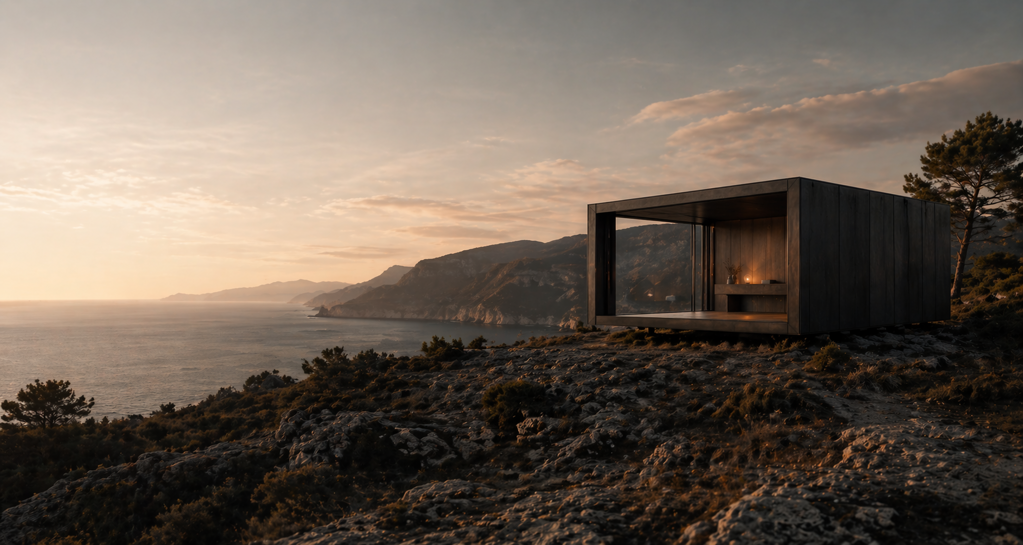
It begins when a space enters into relationship with a context so precisely that its presence feels less like addition and more like recognition. Less like imposition, more like accord. Less like architecture asserting itself upon a site, and more like architecture discovering the exact terms under which it may remain there with dignity.
This distinction matters because much of the built world has been shaped by a different instinct.
For a long time, the central question was one of possibility:
Where can architecture go?
Where can it be built?
Where can it be made to stand, operate, endure and perform?
Those questions were not irrelevant. They produced entire traditions of engineering, planning and settlement. They allowed architecture to extend itself across climates, terrains and conditions that would once have been considered resistant or inaccessible. They expanded reach.
But reach is not the same as belonging.
A structure may be technically successful and still remain culturally or emotionally misplaced. It may perform efficiently, solve practical demands and satisfy all visible requirements of comfort, access and permanence, while still feeling fundamentally indifferent to the character of the place it occupies.
In such cases, the architecture exists.
But it does not belong.
This is increasingly the tension that defines the future.
Because the landscapes most worth inhabiting are no longer approached innocently. We enter them now with a heightened awareness of fragility, saturation, overexposure and the violence with which architecture can too easily consume the very conditions it claims to celebrate. The mountain is no longer simply a view to capture. The coastline is no longer simply an edge to occupy. The desert is no longer simply emptiness awaiting a gesture.
They have become more demanding presences in their own right.
To belong within them requires a different discipline.
It requires landscape-first thinking.
That does not mean treating architecture as secondary in importance, nor reducing it to camouflage or aesthetic modesty for its own sake. It means beginning from the premise that the land is not a stage set for design, but a condition of truth. A place with atmosphere, scale, memory, weather, silence, exposure and limit — all of which must be read before architecture is permitted to speak.
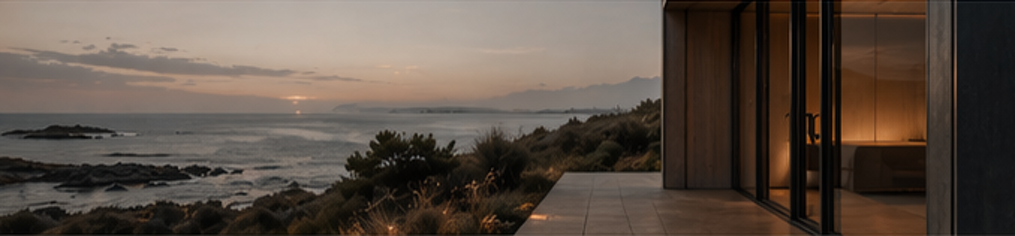
Architecture then ceases to begin with the object.
It begins with relation.
With the fall of light across a ridge at a certain hour.
With the way a horizon opens or withholds itself.
With the distance required for privacy to feel real.
With the degree to which intervention must remain quiet in order for experience to remain elevated.
With the question of whether a place wants presence at all — and if so, how much.
These are not decorative concerns.
They are architectural ones.
Because architecture, at its highest level, does not merely solve occupation. It interprets belonging.
And belonging, in a more contemporary sense, is becoming increasingly selective.
It is no longer enough to say that a structure can be placed in many contexts. The more difficult question is whether it should be placed in them, and under what terms. Whether the result strengthens the atmosphere of the place or weakens it. Whether the intervention preserves rarity or dilutes it. Whether it clarifies the site’s identity or merely borrows its beauty.
This is why the future of belonging is inseparable from selective placement.
Selective placement is not exclusion for its own sake. It is discipline applied to context. It is the refusal to treat all sites as equivalent simply because they are available. It is the recognition that a meaningful architectural language must know when to appear, where to appear and when to remain absent.
In this sense, restraint becomes a form of intelligence.
To place selectively is to understand that some landscapes ask for almost nothing. That some settings become ordinary the moment they are over-articulated. That some experiences derive their power precisely from the fact that architecture has entered with enough precision to be felt, but not enough aggression to dominate.
This is where belonging becomes a more exact standard than installation.
Installation asks whether something can be done.
Belonging asks whether it can be done truthfully.
Installation is satisfied with resolution.
Belonging asks for alignment.
Installation often follows programme.
Belonging follows atmosphere, rhythm and relation.
That difference changes the cultural role of architecture in luxury.
For much of the past, luxury environments were often measured through abundance of means: larger footprints, stronger gestures, more extensive control over territory, more visible signals of exclusivity. Belonging, by contrast, introduces another scale of value.
Not how much architecture can occupy.
But how little it may need in order to feel complete.
Not how loudly it announces privilege.
But how quietly it confirms it.
Not how universally it can be replicated.
But how precisely it can answer the singular conditions of a site.
Here, architecture becomes less generic and more exacting. Less interested in proving itself across all contexts, and more committed to becoming fully itself within the right ones.
That may be the most important shift now underway.
The question is no longer where architecture can go.
The question is where it becomes most true to itself.
Truth, in this sense, is not style. It is congruence.
A congruence between form and land.
Between scale and horizon.
Between material and climate.
Between interior stillness and exterior condition.
Between the ambition of the architecture and the dignity of the place receiving it.
When this congruence exists, belonging becomes perceptible almost immediately. The architecture feels inevitable, even if unfamiliar. Measured, even if contemporary. Calm, even if highly distinctive. It does not ask the site to justify it. The site and the architecture begin to complete one another.
That is a rare achievement.
And rarity is precisely why belonging will matter more in the future.
Because the next era of luxury will not be defined only by access to exceptional places, but by the intelligence with which those places are entered. Because private architecture will increasingly be judged not only by what it offers its inhabitants, but by what it preserves in the context around it. Because hospitality itself is shifting away from spectacle and toward atmospheres that feel more selective, more intimate and more difficult to imitate.
In that world, belonging becomes more than a poetic word.
It becomes a criterion.
A way of deciding where architecture should appear.
A way of understanding when enough is enough.
A way of protecting both landscape and experience from becoming generic through overexposure.
The future of belonging therefore asks more from architecture than mobility, permanence or image alone ever could.
It asks for listening.
It asks for reduction.
It asks for control.
It asks for the humility to know that not every place needs to be claimed in order to be inhabited meaningfully.
And it asks for one final discipline: the ability to distinguish between presence and intrusion.
That distinction may define the next standard of private architecture.
Not architecture that merely arrives.
Not architecture that merely performs.
But architecture that becomes true in the place it enters.
Because to belong is not simply to stand somewhere.
It is to enter a context with such precision, discretion and clarity that what remains feels not imposed, but inevitable.
Reach is not the same as belonging.
Installation asks whether something can be done.
Belonging asks whether it can be done truthfully.
The question is no longer where architecture can go.
The question is where it becomes most true to itself.
CONTINUE READING
PRIVATE ENQUIRIES
For selected hospitality operators, private landowners, investors and exceptional placement contexts.
Request Private Dossier