

Private architecture for extraordinary places.
DEVELOPED IN ITALY
@ 2026 échelon space™ - All rights reserved.
JOURNAL | ESSAY 01
On Nomadic Luxury
A different relationship between movement, place and belonging.
Luxury has long been framed through the language of permanence.
For generations, its symbols have been weight, monumentality and possession: the estate fixed to its land, the residence defined by scale, the destination secured through ownership and distance from the ordinary. The idea of value was closely tied to rootedness — to what could not move, could not shift, could not be lightly reimagined.
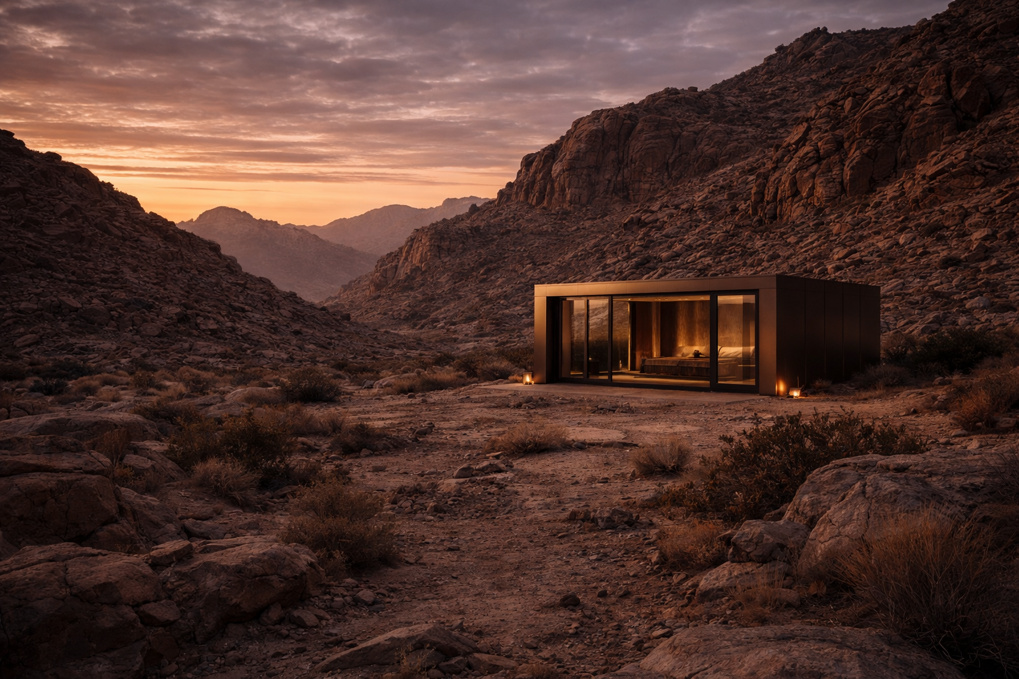
Yet a quieter and more contemporary idea is beginning
to emerge.
One in which luxury is no longer measured only by permanence of construction, but by precision of placement. No longer by excess of matter, but by quality of presence. No longer by the obligation to remain, but by the freedom to belong more selectively, more lightly and more intentionally.
This is the territory in which
nomadic luxury begins.
Not as transience.
Not as instability.
And certainly not as improvised mobility.
But as a more evolved relationship between architecture and place — one that allows a space to remain deeply considered, highly refined and emotionally resonant, without being trapped by the older logic of fixity alone.
In this view, movement is not the opposite of value. It can become one of its highest expressions.
To move selectively is not to diminish meaning, but to protect it from becoming automatic. It is to choose context with greater care. To understand that a setting is not simply a backdrop to architecture, but part of its emotional and cultural completion. To recognise that a place may be extraordinary not because it is permanently occupied, but because it is entered with precision, restraint and timing.
Luxury, then, begins to shift away from possession in its most conventional form and toward something subtler: access, alignment, atmosphere, belonging.
The value is no longer only in owning a place forever. It may also be in knowing where one should belong now, and how architecture can enter that place without violence, noise or unnecessary permanence of gesture.
When that happens,
presence becomes
more powerful
than permanence alone.
And luxury, rather than
becoming fixed,
becomes exact.
This changes the role of design itself.
Architecture is no longer asked merely to impose itself upon landscape, nor to prove its legitimacy through mass. It is asked to do something more difficult: to arrive with dignity, to remain with discretion, and to create an atmosphere strong enough to feel lasting even when its relationship to the site is more intelligent, more sensitive and less absolute.
That is why nomadic luxury should not be confused with mobility as novelty. It is not about movement for its own sake. It is about the possibility of retaining refinement, intimacy and architectural seriousness while allowing one’s relationship to place to become more exact.
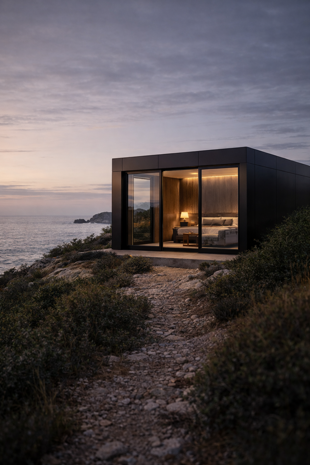
A rarer horizon in summer.
A protected mountain stillness in autumn.
A private coastal silence for a season.
A destination whose meaning lies precisely in the fact that it has not been overrun,
overbuilt or made ordinary through permanence without thought.
In this sense, nomadic luxury is not less rooted. It is rooted differently.
It roots itself not in concrete alone, but in discernment.
Not in fixed possession alone, but in cultivated belonging.
Not in monumentality, but in emotional precision.
Its question is no longer simply: What do I own?
But rather: Where does this life, this architecture,
this experience most meaningfully belong?
That question carries with it a different form of privilege.
A privilege not of accumulation,
but of access.
Not of scale, but of selection.
Not of permanence as status, but of placement as intelligence.
And perhaps this is where a more contemporary vision of luxury begins to separate itself from the older one.
The older model often sought to prove importance through endurance, weight and visibility. The new one may seek instead to express confidence through calm, discretion and the refusal to occupy more than is necessary.
It is not less luxurious.
It is more precise.
It accepts that the most memorable experiences are not always those attached to the largest structures,
the most permanent claims or the heaviest gestures.
They may instead be those in which architecture, landscape and time come briefly — but perfectly — into alignment.
CONTINUE READING
PRIVATE ENQUIRIES
For selected hospitality operators, private landowners, investors and exceptional placement contexts.
Request Private Dossier