

Private architecture for extraordinary places.
DEVELOPED IN ITALY
@ 2026 échelon space™ - All rights reserved.
JOURNAL | ESSAY 05
Smaller,
Rarer, More
Meaningful
Why the future of luxury hospitality
is becoming more intimate in scale.
"
Why the future of luxury hospitality is becoming more intimate in scale.
The most memorable forms of luxury are no longer necessarily the largest.
For a long time, scale was treated as proof.
The grander the arrival, the more expansive the footprint, the more numerous the spaces, the more complete the promise of exclusivity appeared to be.
Luxury announced itself through amplitude: larger suites, larger lobbies, larger gestures, larger claims upon landscape and attention alike.
Size was not simply practical.
It was symbolic.
It suggested abundance.
It suggested distance from limitation.
It suggested that value could be measured in how much space one controlled, how much territory could be framed as private, how extensively comfort could be multiplied and displayed.
That logic has not disappeared.
But it has begun to lose its authority.
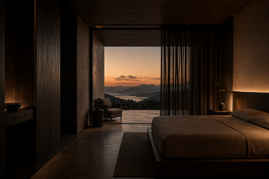
Because the most memorable forms of luxury are no longer necessarily the largest. Increasingly, what remains with people is not vastness for its own sake, but atmosphere. Not quantity of space, but quality of experience. Not scale as spectacle, but intimacy as precision.
This is not a reduction in ambition.
It is a refinement of it.
"
Smaller, in this sense, does not mean lesser.
It means more concentrated.
More exact.
More difficult to imitate.
A smaller luxury space has less room to hide behind excess. It cannot rely on grandeur alone, nor on the old equation by which more volume automatically implied more value. It must work harder at the level that matters most: proportion, material, silence, light, sequence, emotional control.
Everything becomes more exposed.
The threshold matters more.
The framing matters more.
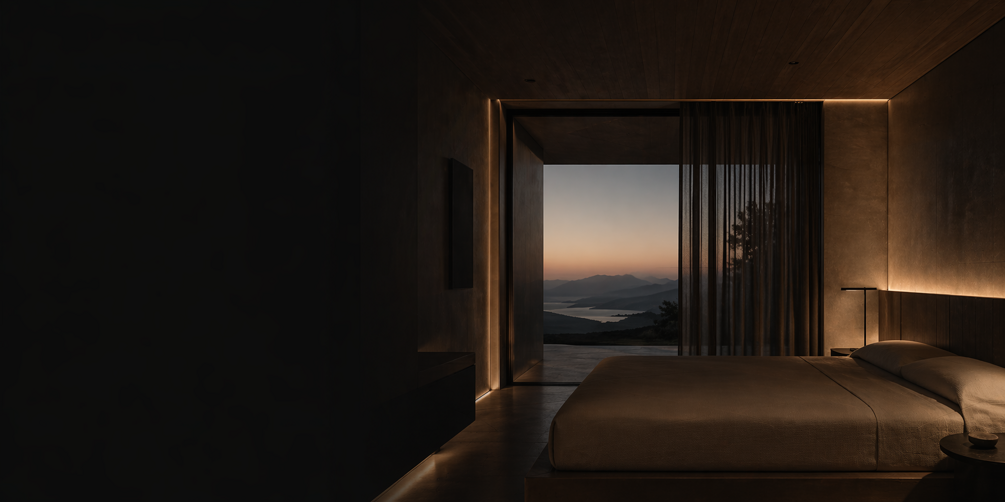
The distance between bed and horizon matters more.
The way a surface receives light matters more.
The way a room protects stillness matters more.
The way privacy is felt, rather than merely advertised, matters more.
This is why intimacy has become one of the defining conditions of contemporary luxury hospitality.
Not intimacy as domestic smallness.
Not intimacy as compromise.
But intimacy as a more selective calibration of experience.
The guest is no longer looking only for size.
The guest is looking for the feeling that a place has been composed with extraordinary care around a more private rhythm of inhabitation.
A quieter arrival.
A slower room.
A more exact relation to view, sound, material and distance.
An atmosphere that does not need to overwhelm in order to remain unforgettable.
The future of luxury hospitality, then, may depend less on expansion and more on precision.
This is partly cultural.
We are living in a time saturated by excess: visual excess, informational excess, programmatic excess, hospitality excess. Many spaces no longer feel generous when they become larger. They simply become louder. More programmed, more styled, more eager to reassure the guest that something important is happening.
But importance does not always need amplification.
In many cases, the opposite is becoming true.
The more refined the hospitality experience, the more it is able to edit itself.
To remove the unnecessary.
To reduce the visible effort.
To make space not for more features, but for more presence.
This is where rarity begins to replace magnitude as the true measure of value.
This is why emotional precision is becoming so central.
Emotional precision is the ability of a place to create a highly resolved feeling without relying on obvious demonstration. It is the reason a room may feel deeply luxurious without being large. The reason a single framed view may carry more power than an oversized suite. The reason a protected threshold at dusk may remain more vividly in memory than a sequence of extravagant but generic spaces.
It is also why intimacy and exclusivity are becoming newly aligned.
In the past, luxury often signalled exclusivity by distance: distance from ordinary life, distance from other people, distance through gates, land and visible privilege. That still matters. But increasingly, exclusivity is being felt in another register: the sense that something has been made with unusual care for very few, and that its atmosphere has not been weakened by scale.
This is more subtle than luxury of display. It is also more durable.
Because what people remember most is rarely just the size of a room. They remember how a place altered their breathing, their pace, their level of attention. They remember the degree to which it allowed them to feel more protected, more exact, more quietly elevated. They remember the atmosphere of having entered somewhere not merely expensive, but deeply resolved.
And resolution is not the same as size.
A meaningful hospitality space may occupy less land, less visual territory, less conceptual noise — and yet produce a more lasting impression precisely because it knows where to stop. It does not confuse generosity with expansion. It does not confuse completeness with saturation. It does not confuse luxury with scale alone.
This is particularly important now because landscape itself has become part of the ethical and emotional standard of hospitality.
The most desirable destinations are increasingly those where rarity must be protected, not consumed. In such contexts, smaller and more precise hospitality is not only aesthetically stronger. It is culturally more intelligent. It allows architecture to become more intimate without becoming trivial, and more exclusive without becoming heavy.
This is why emotional precision is becoming so central.
Emotional precision is the ability of a place to create a highly resolved feeling without relying on obvious demonstration. It is the reason a room may feel deeply luxurious without being large. The reason a single framed view may carry more power than an oversized suite. The reason a protected threshold at dusk may remain more vividly in memory than a sequence of extravagant but generic spaces.
It is also why intimacy and exclusivity are becoming newly aligned.
In the past, luxury often signalled exclusivity by distance: distance from ordinary life, distance from other people, distance through gates, land and visible privilege. That still matters. But increasingly, exclusivity is being felt in another register: the sense that something has been made with unusual care for very few, and that its atmosphere has not been weakened by scale.
"
A rare experience is not one that offers everything.
It is one that offers what matters, with uncommon exactness.
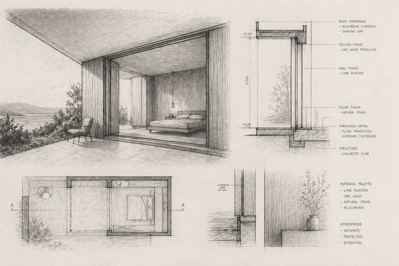
Rare because it is not built for everyone.
Rare because access is selective.
Rare because the atmosphere has not been diluted through over-distribution.
Rare because the architecture has not been asked to perform as inventory.
Rare because the experience remains intact precisely by resisting repetition.
This is a profound change in the meaning of luxury hospitality.
For decades, luxury often advanced by accumulation:
more services,
more square metres,
more amenities,
more visible signs of completion.
Now another standard is emerging.
What if luxury is not the place that contains the most, but the place that edits most intelligently?
What if the deepest comfort is not found in abundance alone, but in the removal of friction?
What if memorability depends not on how much has been added, but on how little has been compromised?
These questions are not stylistic.
They are structural.
Because the intimate luxury space must carry more emotional weight with less architectural noise. It cannot rely on endless succession, on endless furniture, on endless visual reassurance. It must create meaning through relation.
Relation between interior and landscape.
Between enclosure and openness.
Between shelter and horizon.
Between material calm and emotional charge.
Between what is offered and what is left unsaid.
This is what makes smaller hospitality more demanding, not less.
A large space can afford a degree of imprecision.
A smaller one cannot.
Every dimension becomes legible.
Every decision becomes moral.
Every gesture is either justified or exposed.
If the scale is intimate, proportion must be exact.
If the footprint is compact, the atmosphere must be deeper.
If the room is smaller, the silence must be stronger.
If the architecture occupies less, what remains must feel more deliberate, not less.
The result is a new kind of luxury hospitality:
less monumental,
more private;
less extensive,
more exact;
less demonstrative,
more memorable.
Not because grandeur has no place.
But because intimacy now carries a different kind of prestige.
The prestige of control.
The prestige of rarity.
The prestige of knowing that what has been reduced has not been diminished, but clarified.
This is where the future becomes most interesting.
Because a smaller space, when conceived with enough intelligence, can feel larger in meaning than a much bigger one. It can offer greater stillness, greater protection, stronger relation to place, more coherent privacy and a more selective form of desire.
It can feel less like accommodation and more like belonging.
Less like inventory and more like authorship.
Less like hospitality product and more like an atmosphere one enters only rarely.
That rarity is not accidental.
It is designed.
Designed through editing.
Through discipline.
Through the refusal to expand beyond what the experience truly requires.
And that is why the future of luxury hospitality is becoming more intimate in scale.
Because the world has already learned how to make luxury bigger.
What it is only beginning to relearn is how to make luxury exact.
Smaller.
Rarer.
More meaningful.
"
"
"
"
The most memorable forms of luxury are no longer necessarily the largest.
A rare experience is not one that offers everything.
It is one that offers what matters, with uncommon exactness.
The world has already learned how to make luxury bigger.
What it is only beginning to relearn is how to make luxury exact.
Smaller, in this sense, does not mean lesser.
It means more concentrated.
CONTINUE READING
PRIVATE ENQUIRIES
For selected hospitality operators, private landowners, investors and exceptional placement contexts.
Request Private Dossier