

Private architecture for extraordinary places.
DEVELOPED IN ITALY
@ 2026 échelon space™ - All rights reserved.
JOURNAL | ESSAY 02
Private Architetture
Beyond Performance
Why architecture no longer needs to be bound to one model of permanence to feel meaningful.
Private architecture has long been measured through permanence.
Its legitimacy was often tied to what could endure physically, occupy land conclusively, and resist time through weight, construction and fixity. To build meant to remain. To remain meant to matter. And meaning, in turn, was often confused with the degree to which architecture could anchor itself irreversibly to a site.
That equation no longer feels sufficient.
Not because permanence has lost value.
But because it is no longer the only language through which value can be expressed.
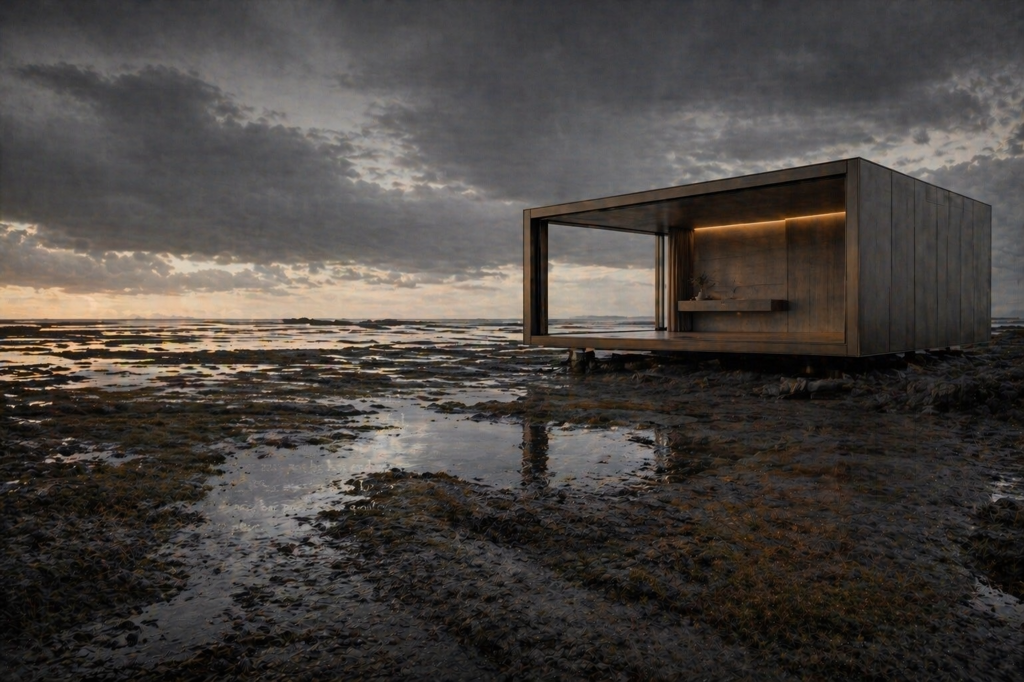
A more contemporary understanding of private architecture is beginning to emerge — one in which significance is not determined solely by mass, duration or the immovability of form, but by something less obvious and perhaps more demanding: the quality of presence, the intimacy of experience and the precision of relationship between architecture and place.
This changes the question architecture is asked to answer.
The older question was often: How permanently can this be built?
The newer one may be: How meaningfully can this belong?
That shift is not superficial. It alters the entire cultural position of architecture.
For much of modern history, permanence was treated almost as a moral category. The fixed building was assumed to be the serious one. Weight implied legitimacy. Concrete implied intention. Endurance implied value. The most credible architecture was often the architecture that could least be moved, least rethought, least released from the site it claimed.
Yet this logic belonged to a world in which land, ownership, settlement and continuity were understood differently. It emerged from a civilisation shaped by monument, inheritance, stability and the visible performance of rootedness.
The present is more complex.
Contemporary life is increasingly defined not by the absence of attachment, but by the multiplication of contexts in which attachment may occur. One may belong deeply to a coastline for a season, to a mountain atmosphere for a period of restoration, to a private estate under one set of circumstances, and to another landscape when life, rhythm or purpose shifts. Meaning does not disappear because permanence becomes less singular. In many cases, it becomes more exact.
This is why private architecture beyond permanence should not be mistaken for architecture without seriousness.
To build beyond permanence is therefore not to build without depth. It is to recognise that depth may come from relation rather than mass alone.
A private space may become meaningful because it opens one perfectly judged frame toward a valley at dawn. Because it introduces silence where noise once dominated. Because it allows temporary withdrawal without improvised compromise. Because it makes a setting more inhabitable without making it ordinary. Because it grants access to a form of belonging that is both intimate and selective.
"
What matters in such cases is not simply whether the structure could remain forever.
"
What matters is whether it transformed the experience of the place while present.
Whether it elevated it.
Whether it entered with dignity.
Whether it left the landscape more understood, rather than more consumed.
This is one reason why the future of private architecture may become less trapped by older conventions of permanence.
The convention assumed that meaning required immobility.
The future may reveal that meaning requires precision.
The convention assumed that seriousness required mass.
The future may reveal that seriousness requires control.
The convention assumed that value had to be fixed into the ground in order to feel real.
The future may reveal that value may also arise through a more exact, less violent and more adaptive relationship with context.
None of this suggests that all architecture should become temporary, nor that permanence itself should be abandoned as an ideal. There will always be buildings whose depth depends precisely on remaining, enduring and aging in place. But to treat that model as the only valid one is to mistake a historical condition for a universal truth.
Architecture has always evolved when its deepest assumptions were questioned.
The next evolution may not be toward less meaning, but toward a more selective distribution of meaning:
less automatic permanence,
more intentional presence;
less construction as assertion,
more architecture as belonging.
In that world, private architecture is no longer forced to choose between seriousness and flexibility, between refinement and responsiveness, between intimacy and legitimacy.
It may instead begin to occupy a more interesting territory — one in which a space can be deeply considered, emotionally resonant and culturally precise without being bound to a single inherited model of what permanence is supposed to look like.
That possibility matters.
Because the landscapes most worth inhabiting are often the ones least suited to careless permanence.
Because the most valuable forms of privacy are increasingly those that preserve relation rather than dominate it.
Because the future of luxury may depend less on how much is fixed, and more on how intelligently something belongs.
"
It is not a reduction in architectural ambition.
It is a refinement of it.
"
The challenge is no longer simply to build in a way that lasts, but to create forms of presence capable of carrying emotional, spatial and cultural weight without relying exclusively on irreversibility as proof of value.
In this sense, permanence itself begins to separate into two different meanings.
There is permanence as physical fixation — the condition of being permanently attached, permanently constructed, permanently resolved in one place.
And there is permanence as intensity of impression — the condition by which something remains in memory, alters one’s relationship to a landscape, and acquires meaning not because it cannot move, but because it was placed with such precision that its presence feels inevitable.
The second may, in certain cases, matter more.
A structure may remain for decades and leave little trace in the mind. Another may enter a place with such exactness, restraint and emotional clarity that it feels lasting even beyond its material duration. What remains then is not only the object, but the relation it established: between light and shelter, between horizon and threshold, between intimacy and distance from the ordinary.
This is where private architecture becomes more subtle.
It is no longer defined only by possession of land or by the scale of intervention, but by a more cultivated intelligence of placement. Architecture begins to behave less like a claim and more like a calibration. Less like occupation, more like alignment. Less like proof of ownership, more like proof of understanding.
"
And because architecture, at its highest level, has never been only about staying.
It has been about making presence meaningful.
"
"
That does not weaken architecture.
It asks more of it.
It asks architecture to be exact enough to belong
without excess.
Restrained enough to remain quiet.
Strong enough to create atmosphere.
And disciplined enough to resist the temptation to
overbuild in order to appear meaningful.
"
CONTINUE READING
PRIVATE ENQUIRIES
For selected hospitality operators, private landowners, investors and exceptional placement contexts.
Request Private Dossier