

Private architecture for extraordinary places.
DEVELOPED IN ITALY
@ 2026 échelon space™ - All rights reserved.
JOURNAL | ESSAY 03
Designing Silence
How atmosphere, restraint and proportion create a rarer form of luxury.
"
Silence is never accidental.
In architecture, it is composed.
This is why true luxury often feels quieter than expected.
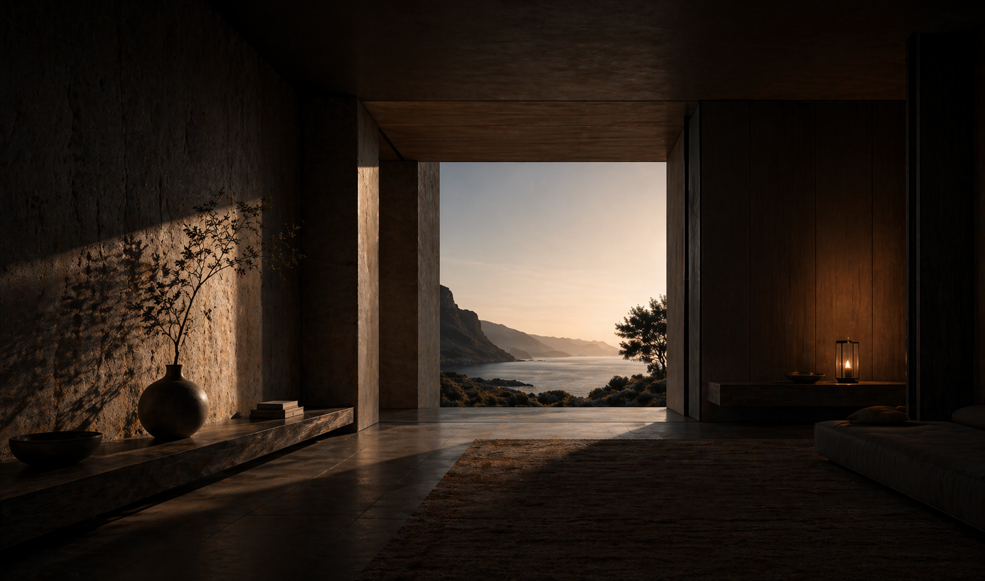
Not as the mere absence of sound, and not as emptiness for its own sake, but as a condition carefully brought into being — through material, light, distance, scale and what is deliberately left unresolved. Silence does not simply happen when noise is removed. It begins when architecture becomes disciplined enough to stop speaking more than it should.
This is why silence is one of the rarest luxuries.
Not because it is difficult to recognise once encountered, but because it is difficult to create without misunderstanding it. Much of what presents itself as luxury today still relies on the opposite instinct: more surfaces, more gesture, more spectacle, more visible expense, more signals designed to confirm that value has been achieved. The result may be impressive. It may be expensive. It may even be desirable for a moment. But it rarely becomes quiet.
Value was communicated by accumulation: of detail, of preciousness, of visible intervention. This logic still survives, even in contemporary forms. Excess has simply become more polished. Display has become more discreet, but remains display all the same.
"
Its effect does not come from impact alone.
It comes from composure.
And what is not quiet rarely becomes lasting. Silence belongs to another order of refinement.
Silence requires another confidence.
It cannot be added as a final layer.
It cannot be styled into existence.
It cannot be simulated through minimalism alone.
It has to be composed from the beginning, because it depends not on what architecture shows, but on what it controls.
It begins where architecture no longer feels compelled to prove its worth through constant emphasis. It begins when space trusts atmosphere more than ornament, proportion more than theatricality, and material dignity more than decorative insistence. A silent interior is not an empty one. It is an interior in which each element has been reduced to the point at which nothing disturbs the whole.
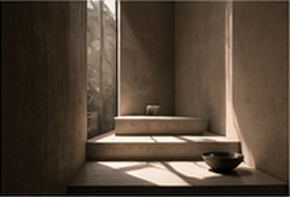
The light it permits. The shadows it allows to remain.
The width of a threshold.
The distance between object and horizon.
The weight of a wall. The restraint of a material.
The proportion of a room. The refusal to complete every surface with explanation.
These are not secondary matters. They are the architecture of silence itself.
For a long time, luxury was often defined through abundance. The richer space was the fuller one, the more adorned one, the more elaborately resolved one.
That reduction is not austerity.
It is precision.
A silent space can be warm, sensual, deeply luxurious. It can hold stone, wood, fabric, bronze, shadow, reflection and stillness. But each of these must enter under control. None may dominate for its own sake. None may become eager. None may call attention to itself so loudly that the atmosphere fractures into parts.
From the exact degree to which architecture knows how to stop.
Where to leave air around an object.
Where to allow darkness to remain intact.
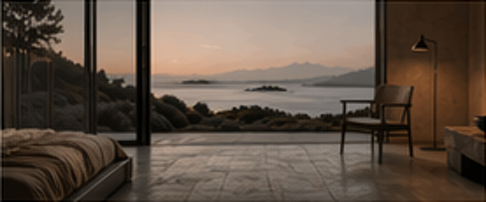
Where to let the horizon complete what the room does not need to say.
Where to leave a surface calm enough for light to become the only event required.
Silence, then, is not merely a mood.
It is an achievement of measure.
Measure in scale: when a room is large enough to breathe, but intimate enough to protect.
"
Measure in material: when surfaces absorb, reflect and temper experience rather than competing within it.
One moves differently in a silent space.
More slowly.
More attentively.
Less defensively.
This is the point at which restraint becomes not denial, but generosity.
Measure in light: when illumination reveals without flattening, and shadow remains part of the architecture rather than something to be eliminated.
To restrain architecture is not to deprive it of richness. It is to return richness to its highest form: atmosphere. An atmosphere cannot be purchased as an object.
It must be composed through decisions so exact that the resulting calm feels natural, even inevitable. This is what makes silent architecture so seductive. It does not impose itself on the body. It receives the body and alters its rhythm.
Measure in distance: when the separation between one thing and another allows perception to deepen rather than collapse into clutter.
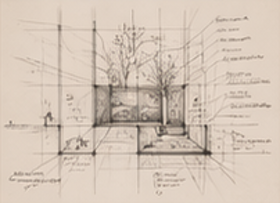
One begins to notice things that spectacle usually destroys: the temperature of shadow on stone, the edge of light across timber, the interval between interior calm and exterior distance, the feeling that nothing has been over-decided and therefore nothing is pressing against the mind.
This is a deeper form of luxury because it returns experience to perception.
And perception, in the end, is where all refined architecture is judged.
A place may be expensive and still feel noisy.
A place may be large and still feel airless.
A place may be visually sophisticated and still feel spiritually crowded.
Silence is what separates luxury from mere premium condition.
Because silence cannot be faked for long.
It reveals proportion immediately.
It reveals whether materials were chosen for dignity or effect.
It reveals whether light has been understood.
It reveals whether architecture was conceived as a background for living, or as an anxious performance of itself.
That is why silence has become increasingly important in a culture saturated by visual insistence.
The world outside grows louder, faster, brighter, more explicit, more complete.
More and more environments are designed to prevent pause:
every surface activated, every space over-programmed, every moment optimized against stillness.
Under such conditions, silence stops being decorative and becomes restorative.
"
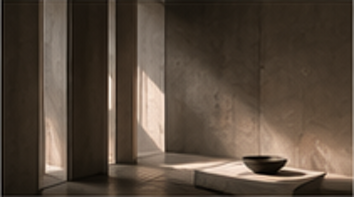
Not restorative in a therapeutic cliché.
Restorative as return.
A return to spaces in which nothing is demanding immediate reaction.
A return to rooms that do not exhaust themselves through over-articulation.
A return to architecture capable of preserving one’s interior rhythm rather than fragmenting it.
This is where silence becomes inseparable from presence.
Because a silent architecture is not an absent one.
On the contrary, it is often more deeply present than louder forms of design.
Its presence is simply not based on interruption. It does not seek to be admired all at once. It reveals itself through duration. Through repeated occupancy.
Through the slow recognition that what first felt calm begins to feel exact.
"
Silence is never accidental.
In architecture, it is composed.
What is not quiet rarely becomes lasting.
Restraint is not denial.
It is precision.
In such places, silence is not the background to luxury.
It is its highest expression.
That exactness is often carried by proportion more than by image.
A door slightly taller than expected.
A threshold set deeper into wall thickness.
A glazing line held with precision.
A bed placed at the distance required for horizon, not simply for function.
A material transition resolved softly enough that the eye moves without friction.
A room whose dimensions hold the body without either compression or emptiness.
These are quiet decisions.
Yet they shape the entire emotional register of a place.
This is also why what is left unresolved matters so much.
Not in noise refined.
Not in excess disciplined just enough to seem tasteful.
But in the ability to create rooms, thresholds and landscapes in which stillness acquires weight, and where nothing needs to be raised in volume to feel extraordinary.
In such places, silence is not the background to luxury.
It is its highest expression.
Because when architecture becomes quiet enough, proportionate enough and restrained enough, something deeper appears.
Not spectacle.
Not performance.
Not visual satisfaction alone.
But presence.
And presence, when fully composed, is what the most memorable luxury has always been seeking.
⸻
Luxury often assumes completion is the goal. Silence suggests something subtler. A space may become more powerful when not every edge is over-defined, not every object over-curated, not every emptiness filled for reassurance. What remains open allows imagination, breath and time to enter. It gives atmosphere room to deepen. It leaves the occupant with the feeling that architecture is supporting presence, not closing around it.
To design silence, therefore, is not to design less.
It is to design with greater responsibility.
Responsibility toward attention.
Toward the body.
Toward atmosphere.
Toward the difference between comfort and sedation, between calm and vacancy, between luxury and excess.
It asks architecture to know exactly how much is enough.
And perhaps that is where the rarest form of luxury now resides.
CONTINUE READING
PRIVATE ENQUIRIES
For selected hospitality operators, private landowners, investors and exceptional placement contexts.
Request Private Dossier