

Private architecture for extraordinary places.
DEVELOPED IN ITALY
@ 2026 échelon space™ - All rights reserved.
JOURNAL | ESSAY 06
Italian Precision, Contemporary Calm
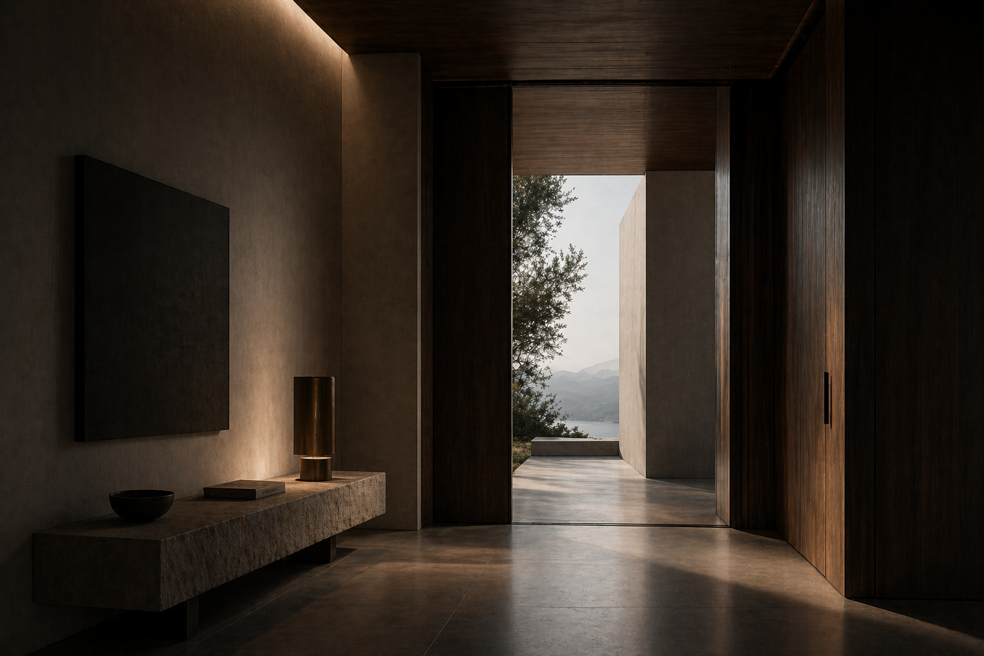
Why the most refined luxury no longer needs to announce itself loudly.
There is a kind of luxury that still believes it must be seen immediately.
It announces itself through abundance, through emphasis, through visible effort. It fills space in order to reassure. It multiplies material, gesture and detail in the hope that refinement will become undeniable by sheer accumulation. It wants to be recognised without delay, and often without silence.
That language has not disappeared.
But it no longer defines the highest form of refinement.
Because what now feels most elevated, most lasting and most difficult to imitate is often something quieter: a luxury composed not through insistence, but through exactness. Not through ornamental declaration, but through proportion. Not through visual noise, but through calm.
This is where precision becomes cultural.
And this is also where a certain Italian instinct remains uniquely relevant.
Not the Italy of stereotype.
Not the Italy of decorative nostalgia.
Not the Italy reduced to gesture, romance or theatrical beauty.
But the Italy of measure.
The Italy that understands that elegance is rarely created by addition alone. That a line acquires force when it is held correctly. That material becomes noble not when it is over-celebrated, but when it is placed under discipline. That luxury, if it is to endure, must know how to lower its voice without losing authority.
This is a different inheritance.
An inheritance of proportion before spectacle.
Of composition before display.
Of atmosphere before effect.
It can be felt in architecture, in objects, in interiors, in tailoring, in the design of thresholds, in the way weight and light are made to coexist without friction. It is present wherever refinement is treated not as decoration, but as control.
But the Italy of measure.
That distinction matters now more than ever.
Because contemporary luxury is increasingly surrounded by noise disguised as sophistication. Surfaces are richer, but often less resolved. Spaces are more expensive, but not always more exact. The visual language of prestige has become widely available, widely imitated and widely overused. As a result, loudness has become easier to produce, while calm has become rarer.
And rarity, increasingly, belongs to calm.
Contemporary calm should not be mistaken for emptiness, nor for an abstract aesthetic of minimalism. It is not the removal of character. It is the refinement of character until nothing remains that is unnecessary, eager or imprecise.
A calm space is not a neutral one.
It is a disciplined one.
Its power lies in what has been resolved without friction:
the proportion of a volume,
the depth of a threshold,
the weight of a wall,
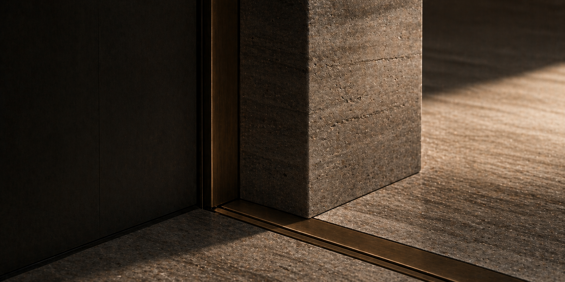
the quiet intelligence of a material transition,
the exact relationship between light, enclosure and view.
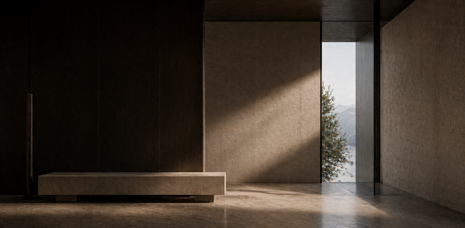
This is where precision stops being technical and becomes emotional.
Because the most memorable spaces are rarely those that explain themselves too quickly. They are the ones that seem composed down to a level the eye cannot fully name, but the body immediately understands. One feels the correctness of the room before one can describe it. One feels that nothing has been forced, that nothing has been left to vanity, that everything has been brought to a degree of calm where attention is no longer fragmented.
This is a very particular form of luxury.
It does not ask for admiration at every step.
It does not depend on surprise.
It does not try to appear exceptional by becoming louder than the world around it.
It becomes exceptional because it remains composed while everything around it becomes excessive.
That composure is what gives it dignity.
And dignity is increasingly one of the rarest values in design.
Italian precision, in this sense, is not about perfectionism as fetish. It is about the ethical quality of adjustment. The belief that things matter at the level of their exactness. That an opening should be placed not merely where it functions, but where it feels inevitable. That a material should age with calm. That a room should hold the body with the right degree of gravity. That architecture should not simply impress, but settle.
To settle a space correctly is one of the most difficult things to do.
It requires restraint.
It requires editing.
It requires the refusal to let every possibility become visible.
It requires confidence strong enough to leave air around an idea.
This is why contemporary calm is not softness.
It is strength under control.
A calm architecture is often more exacting than a dramatic one, because it has fewer distractions behind which to hide. Every line is legible. Every proportion is exposed. Every material choice is asked to justify itself quietly. Nothing may rely on excitement alone.
This makes calm both more demanding and more modern.
Because the future of luxury is not likely to belong to spaces that merely look refined. It will belong to spaces that know how to preserve clarity under pressure: visual pressure, cultural pressure, commercial pressure, the pressure to add, accelerate and perform.
The calm space resists that pressure.
It resists by remaining selective.
By remaining measured.
By understanding that reduction, when intelligent, does not diminish luxury. It reveals it.
This is where the most contemporary expression of Italian precision begins to matter.
Not as a historical style, but as a mode of judgment.
A way of deciding what deserves to remain.
A way of removing what weakens atmosphere.
A way of giving proportion the authority that excess once tried to claim for itself.
In such a framework, beauty becomes quieter but stronger. Materials become warmer because they are not overstated. Spaces become more intimate because they are not overcrowded with meaning. Luxury becomes more believable because it no longer needs to perform luxury at every moment.
Instead, it creates a condition of trust.
The trust that the room has been thought through.
The trust that silence has been allowed to remain.
The trust that what has been reduced has not been impoverished, but clarified.
The trust that calm here is not accidental, but composed.
That is why the most refined luxury no longer needs to announce itself loudly.
Because what is truly exact has already made its decision.
It no longer needs to negotiate for attention.
It simply remains.
Quiet, measured and unmistakable.
This may be the deepest continuity between Italian precision and contemporary calm: both understand that refinement is strongest when it appears inevitable. When nothing feels exaggerated, and yet nothing feels generic. When the result is not cold, not empty, not decorative, but fully resolved.
That kind of resolution is what the future increasingly demands.
Not more visual theatre.
Not more expensive noise.
Not more gestures of status disguised as atmosphere.
But a more serious form of elegance.
One capable of restraint.
One capable of intimacy.
One capable of carrying cultural weight without becoming heavy.
That is the kind of luxury that lasts in memory.
And perhaps more importantly, it is the kind that becomes more convincing over time, not less. Because it is built not on immediate spectacle, but on sustained correctness. The more one inhabits it, the more exact it feels. The more exact it feels, the quieter it becomes. The quieter it becomes, the more authority it carries.
This is not the end of luxury.
It is luxury, clarified.
Italian in its instinct for proportion.
Contemporary in its refusal of excess.
Calm in its presence.
Exact in its effect.
The highest form of refinement is often quieter than expected.
Contemporary calm is not softness.
It is strength under control.
What is truly exact no longer needs to negotiate for attention.
This is not the end of luxury.
It is luxury, clarified.
CONTINUE READING
PRIVATE ENQUIRIES
For selected hospitality operators, private landowners, investors and exceptional placement contexts.
Request Private Dossier